SEND training for schools: supporting every child to achieve and thrive
28 September 2026
On Friday the DfE published the SEND and inclusion CPD for internal setting use, that is, for SENCOs to deliver at their schools and academies.
You can see it on the DfE website (opens in a new tab), but we've also added it to the Library so you can search across it, and 1197 other SEND and inclusion docs.
Before I get into the commentary, a little background.
Since March, DfE have been running "engagement" sessions with potential suppliers of SEND CPD. There are various packages that are being investigated.
Dingle's Promise have been awarded some online Early Years CPD, (opens in a new tab) which is now live, and you should tell your Early Years settings about it and put it on your SEND Local Offer.
Now, updated materials from Ambition Institute, but branded "DfE", have been made available for SENCOs to run sessions in their settings. One of the biggest changes is the use of Areas of Development. It's the first time I've seen this in official docs, though there is a disclaimer that it's still under consultation.
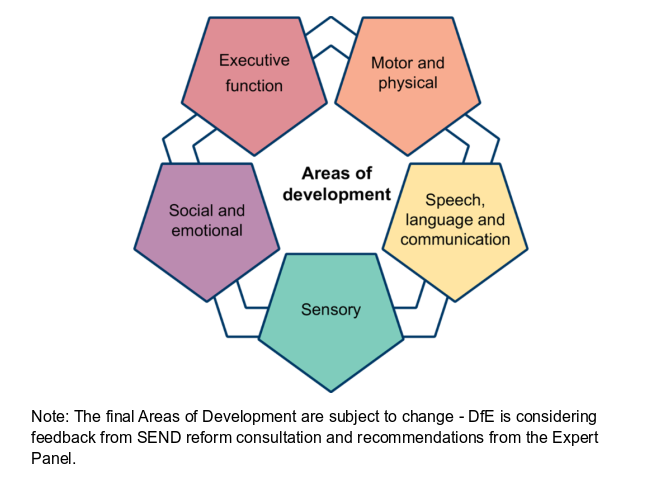
External CPD (and how you can influence it)
Next, there will be a tender competition for external led CPD. We're waiting for the full details of this, but we intend to be part of a consortium to deliver it.
Pop Pop Studio will be looking for people to write the materials and deliver the training. If that could be you, fill in our DfE SEND and inclusion form
So what are people saying about "SEND training for schools: supporting every child to achieve and thrive"?
When teachers ask for more CPD/training for supporting pupils with SEND - which they frequently and clearly do, do we have any idea what they mean?
Michael Tidd. Headteacher
I'd recommend reading that whole thread (and getting onto BlueSky if you are still on X) but here's some more responses
I think that is your (my) job and also the SENDco. I agree entirely, but that is where the role of the SENDco is vital as they should be able to identify any specific needs the child has and be able to source training. Often teachers and TAs just know they need help, I see it as my job to find it.
AR, Headteacher
My experience is not that teachers don't know how to support individual children, so much as they simply don't have the capacity to do so alongside everything else
Michael Tidd, Headteacher
Which suggests "more CPD" is sometimes a request for something else such as time, a colleague to plan with or permission to do less of something... If we answer a capacity problem with a knowledge solution, we add to the load we were meant to ease and that's really squeezing the system lately.
Stuart Rowantree, Assistant Headteacher
I think there is a danger that the teachers assume they are not doing enough - that it is their lack of knowledge - but sometimes it’s that the environment is the issue. And when you have 4 children in a classroom with different environmental needs - training is not the answer.
Holding the line, Headteacher
If the training is there it’s often not available to help teachers in the June-September window it would be most useful. Primary teachers especially discover their class list & needs in the summer & then have to research over their summer break.
Teaching with my eyes shut, recently retired Headteacher
Over on LinkedIn, things were no better, with lots of educators thinking this is the full £200m SEND and Inclusion CPD budget. Or as Jonny Uttley said in the quote at the top, "It's woeful".
But, ever the optimist...
Where do we go from here?
There need to be shared language and expectations, accessible classroom routines, and time for collaboration. Systems for noticing need early. And leadership that makes inclusion part of how the school works, rather than something we do when a particular student is struggling.
Specialists are still essential. But their role should be to strengthen the system, not to become the system.Brenna Weston Bell, Inclusive Education Leader https://lnkd.in/p/ePMgKSBd (opens in a new tab)
Across England the SEND reforms are happening. A key aim is to support schools to be more inclusive.
The DfE have just launched the first training package for schools and it's about SLCN.
It is designed to be delivered by SENCO but I suggest that Speech and Language Therapy and SLCN specialist teacher services should get involved also so they can ensure local delivery is unified and this is not seen as an add on. Take a look and let me know what is happening in your area too.Stephen Parsons SALT https://lnkd.in/p/eFFpPGkB (opens in a new tab)
The question is not simply whether a pupil is behind, but what precisely is getting in the way and what the evidence tells us about it.
This matters particularly for pupils who do not have an identified SEND need but are nevertheless not achieving, participating or becoming as independent as we would expect.
For me, this is where inclusion needs greater precision: not starting with a label or an outcome, but using the evidence we already have to understand the barrier and make the response equally precise.Cindy J Impey, School improvement consultant https://lnkd.in/p/eCXdptm7 (opens in a new tab)
Forensic approach is key to inclusion
RR, Former teacher/school leader/SENDCo https://bsky.app/profile/rlrossi64.bsky.social/post/3mwlzepwfpk2u (opens in a new tab)
I feel like the framework we need to develop is "forensic curiosity". I'm pretty sure there's going to be a module about that in our materials, if we win the DfE bid.
Cheers,
Jonny Holden